
From One Product to a One-Stop Shop
Not every cabling job requires expensive heavy duty steel ladders and rigid wire basket trays. With that thought in mind, in 1996 Snake Tray founder Roger Jette conceived the world’s first hand-bendable cable tray with integrated mounting rings.
Lightweight and flexible, this innovative cable conveyance solution allowed installers to quickly create continuous low voltage data and telecom cable pathways without tools or on-site fabrication, revolutionizing cable management.
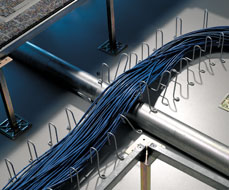 Roger’s original hand-bendable cable tray effortlessly slithered over, under and around any obstacle, navigating the tightest spaces like a snake and inspiring the company name.
Fast forward thirty years and today Snake Tray is recognized as a global leader in cable management and power distribution. In 2026 an expanded family of hand-bendable cable trays optimized for various applications and mounting surfaces now stands alongside lines of prefabricated steel wire basket trays, patented above-ground solar cable conveyance, high efficiency underfloor electrification systems and customizable power and data enclosures, making Snake Tray a one-stop shop for all things cable- and power-related.
Transforming Ideas into Reality
Accepting projects other manufacturers pass on due to excessive customization, time pressures, cost or lack of design skills is our wheelhouse – even one-off endeavors that have never been attempted before. In fact, we like to think of ourselves as an engineering firm with integrated manufacturing capabilities capable of solving any cabling challenge.
Over the past 30 years we’ve seen it all…from new construction requiring miles of cabling for smart building tech (BMS) to upgrading legacy structures to meet modern connectivity requirements. We’ve watched the evolution of the hyperscale AI data center, the rise of utility-grade solar plants and the emergence of battery energy storage systems (BESS) to capture excess power.
And we’ve done it all…innovating new cabling solutions that have become industry standards and some of our best selling products. From micro telecommunications closets to macro data centers, from the depths of subway tunnels to the apexes of skyscrapers, even building cable pathways from scratch that follow the twists and turns of conveyor systems in warehouse distribution centers and roller coasters in amusement parks.
Snake Tray has helped erect temporary hospitals during COVID, modernized assisted living facilities, decades-old government buildings and college dormitories. We have powered museums, casinos and military HQs, keeping electrical connections out of sight with our modular underfloor power distribution system. We’ve transformed brownfields, strip mines and even fossil fuel utility retention ponds into renewable energy producing solar arrays.
Benefit From Our Experience
During this time we’ve amassed a vast library of knowledge pertaining to cable management. We invite you to take advantage of our expertise and customization capabilities, awareness of codes and standards, and tips for best practices to adopt and costly pitfalls to avoid.
While every project is unique, here are a few common lessons we’ve learned that will help make your next cabling job a success:
- Include cable conveyance in initial project planning – not as an afterthought. All buildings today are smart. Avoid the uh-oh moment that occurs when architects realize they failed to plan pathways for the cables that enable all the automation designed into the building. The thousands of low voltage wires for climate control, room access, lighting, AV, security, occupancy sensors and network connectivity must be given the same priority as traditional HVAC, plumbing, fire suppression and electrical infrastructure.
Pre-defined cable pathways are critical to minimizing obstacles and the number of turns and elevation changes, reducing costs via the shortest possible runs while speeding tray installation and cable loading. Account for cable pathways at the start of projects to eliminate problems caused by on-site workarounds and fabrication.
- Speed is of the essence – Part 1: Choose a vendor that can deliver. Cable-intensive hyperscale data centers are dominating the construction front and consuming inventory as quickly as it is produced, straining cable tray supply chains. Plan accordingly. Order well in advance and anticipate delivery delays, especially from overseas manufacturers.
Speed is of the essence – Part 2: Time is money. The faster a project is completed, the faster it earns revenue. Choose a solution that both installs and loads cables quickly.
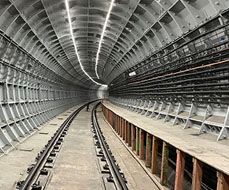
For example, when upgrading the cabling in a mass transit tunnel, we designed a single low-profile apparatus with multiple pockets that accommodated all present and future communications, lighting and signal control cables that also greatly compressed construction schedules.
Rather than bending and clamping multiple pipes to the tunnel wall with thousands of screws and tediously feeding wires through each, our one-piece Snake Rack system easily followed the contours of the tunnel with significantly reduced mounting requirements. Once attached, installers simply dropped cables into rack pockets as fast as they could walk alongside the cable train car that carried them. This enabled the transit line to go back into service – and the authority collect rider fares – months sooner than could be achieved with traditional pipe and wire cabling methods, amounting to tens of millions of dollars in recovered revenue.
 Future proof your cable plant. Bundled and layered cables generate heat and thus have limits on tray capacity to minimize derate, the loss of energy via transfer into heat. Do the math on cable tray fill rates (see Understand codes and standards) and select a tray size and configuration that allows for growth.
Snake Tray makes cable trays in a wide range of widths and depths to accommodate various cable loads within code.
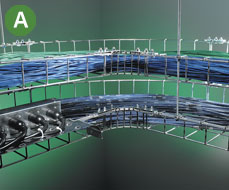
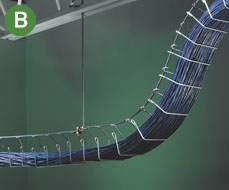
Need more capacity? Hang a threaded rod from a Mega Snake run to add a second tier (A) or choose a two pocket system (B) to double bundled cable volume in one apparatus.
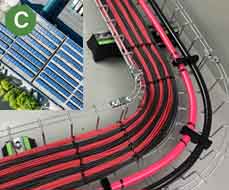
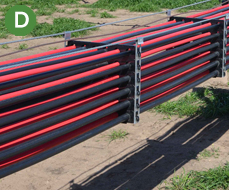
Eliminate the derate issue completely with free-air cable conveyance. Snake Tray’s patented Solar Snake Max features a “click” system to separate cables in rooftop (C) and ground-level solar (D) installations that allows heat to dissipate into the surrounding air, allowing for the use of smaller conductors while maximizing energy harvest.
And all Snake Tray solutions offer easy access to cables for additions, moves, repairs and changes.
- Separate power from data cables. Stay within code and simplify cable management and maintenance by organizing cables by function. This can be accomplished by installing parallel pathways for high and low voltage lines, or by inserting dividers into a single Snake Max pathway to isolate data, fiber optic and voice cables from current-carrying conductors.
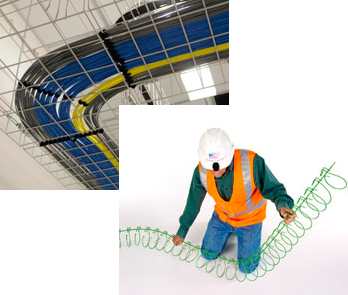 Keep it simple! Select the solution that does the job without overbuild – in other words, apply Roger’s principle that not every job requires heavy duty steel ladders or rigid basket trays.
For example, our 801 Series Mega Snake offers the strength and weight capacity of an aluminum or steel ladder but is constructed from ¼” steel rods for a more lightweight, versatile and fabrication-free solution.
Running just a few cables? Our hand-bendable trays with built-in mounting rings do the job without struts and trapezes. Navigate turns and elevation changes without cutting, grinding or clipping. Complete projects faster with fewer skilled workers and less waste to save on materials, costs and labor.
- Understand codes and standards. The construction industry is regulated by several state, national and federal entities that publish standards for the types, volumes and rules for bundling cables, as well as regulations to ensure safety around high voltage equipment and to meet energy-efficiency standards. Compliance has a critical impact on project planning and can result in costly fines and do-overs if not done right the first time.
Article 392 of the National Electrical Code (NEC) sets cable fill rate at 50% of the interior cross-sectional area of the cable tray (W x D ¸ 2), while NEC Article 310 specifies the minimum spacing between high ampacity solar cables up to 1250 Kcmil in free air to eliminate the effects of derate.
ASHRAE Standard 90.1 (American Society of Heating, Refrigerating and Air-conditioning Engineers) defines the minimum energy efficiency requirements for the design and construction of new commercial buildings. California’s Title 24 sets strict environmental compliance standards for new construction across the state, and many states have adopted similar legislation.
When building a battery energy storage system (BESS), for example, there are minimum setback distances between electrical components and maximum limits for vertical and horizontal reaches to batteries and disconnects that must be adhered to for safety reasons. Other projects may require firestops or barriers between cable pathways.
Not aware of or unsure of how to approach compliance issues for your next project? Consult with local regulatory authorities or pick our brains about codes and standards before breaking ground to prevent accidental violations and ensure your project is up to code. We do this every day. We know what to look for and the questions you may not know to ask.
- Select the proper tray finish for the environment. Recognize that performance can be affected by factors such as exposure to salt water and weather conditions. Choose a tray finish (galvanized, powder coated, stainless steel) that will stand up to anticipated operating conditions and native surroundings. Spending a little more today costs a lot less than having to replace it tomorrow.
Been there. Done that.
Looking for a partner to help your next project succeed? We’ve helped customers solve their cable management and power distribution challenges for 30 years, accumulating dozens of patents in the process.
In a world where time is money, supply chains are strained and skilled electricians are getting harder to find, Snake Tray has solutions designed to install quickly, reduce labor and material costs, and significantly drive down the total cost of construction.
Plus, all Snake Tray products are manufactured from recycled and reusable materials right here in the USA, are available today, and address the growing skills gap by eliminating on-site fabrication.
Have questions? We’re happy to share our thoughts. Contact us today to make your next project the best it can be. Our advice is free, but its value is priceless.
We are Snake Tray. We are cable management. Cheers to the next 30 years!