Making the cost case for Solar Snake Max™
At Snake Tray®, our efforts to educate and promote the benefits of above ground cable conveyance are usually aimed at the constructors of utility-grade solar energy farms – the architects and engineers who design the arrays and the electrical contractors who do the work. Our message to them focuses on speed of installation, less labor, reduced material costs and easy accessibility for repairs by eliminating trenching and the need to derate buried cables.
Here, we’d like to speak to the investors backing hyperscale solar energy and battery energy storage system (BESS) plants. You’re the ones cutting the checks. You have a right to know – and influence – which systems are used in your projects to shorten construction timelines, maximize energy harvest and increase your ROI by selling more energy to utilities.
You also have a right to know why the plant is not generating the amount of power promised by your builders once operational. You signed an agreement with a local utility to purchase all the watt hours you can produce, yet metered energy output is not close to matching expectations even with above ground cable conveyance. As a result, your investment is underperforming and not meeting contractual obligations. No one is happy.
Many systems promise true free-air ampacity without derate, but only Snake Tray guarantees it. The biggest enemy of efficient electrical transference is heat, created through both external environmental exposure and the internal friction of resistance as electrons move along the cables. This article examines why free-air ampacity calculations promised on the drawing board often fail to translate to the field, and why Solar Snake Max is the best solution to the problem.
Free-air cable conveyance defined
Bundled or buried cables lose a sizable percentage (about 8%) of billable energy to heat. The usual fix is to increase conductor size by up to 30% to offset the energy loss. The practice is called derating, but more copper adds more cost.
Above ground (aka “free-air”) cable conveyance allows the heat of electrical friction to dissipate into the surrounding air, maintaining the maximum possible energy throughput without derate. For example, 500 Kcmil cables in free-air space can convey the same power as 750 Kcmil cables when buried – while capturing up to 8% more billable watt hours!
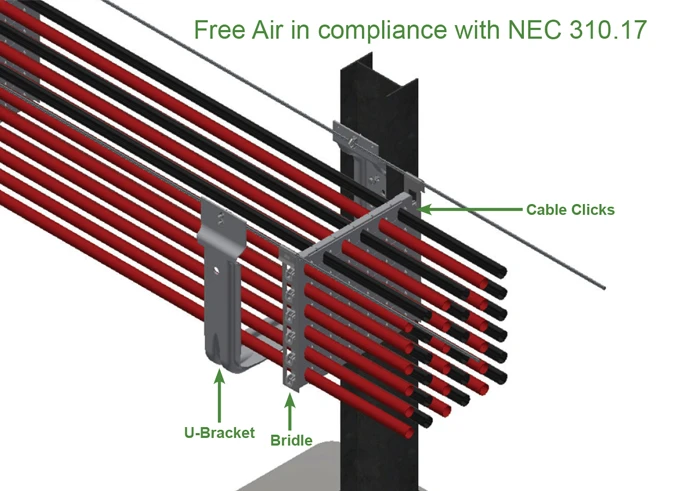
To achieve true free-air cable conveyance NEC section 310.17 states the suspension system must maintain uniform separation on all sides around each individual cable at a distance equal to the cable diameter for the entire length of the run.
Snake Tray did not invent the concept of above ground cable conveyance, but we did invent our patented “click” cable separator technology. Solar Snake Max™ is the only above ground cable management system that complies with NEC requirements for consistent cable spacing to enable true free-air ampacity. Cables stay cooler and energy yield is higher. It’s that simple.
Where free-air goes wrong in the field
Many above ground designs claim to deliver the benefits of free-air ampacity, but the installed cable spacing doesn’t hold up in the field. Without consistent support cables can droop and drift, creating opportunities for electrical resistance and thus negating the free-air energy yield assumptions your engineers promised.
Other issues impacting the management of thermal realities in solar energy production include:
- Mixed cable sizes. Varying ampacity conductor diameters can increase cable separation complexity and violate the “spacing equal to the cable diameter” rule.
- Covered runs. Segments of runs enclosed for safety reasons or when traversing access paths trap heat, making spacing and ventilation more critical.
- Missing hardware. Incorrect or insufficient quantities of cable mounting apparatuses can lead to improvised support methods or bundling that contradict free-air compliance.
- Thermocycling. Environmental effects (wind, sun, moisture), too much or too little slack, and daily temperature fluctuations can cause cables to sag in heat or contract in cold, stressing connection points.
- Metal-on-metal contact. Sharp metallic components that touch cables can damage jacket insulation and lead to electrical shorts and excessive downtime.
Solar Snake Max: Designed for the Constructor and the Investor
Solar Snake Max is the fix that enables solar energy production assumptions to transfer from the drawing board to the real world and deliver on the promise of true free-air ampacity.
Polycarbonate insulated cable separators (the clicks), meet NEC 310.17 requirements for maintaining fixed spacing for up to 36 cables from 350 up to 1250 Kcmil. But the benefits of Solar Snake Max don’t end there.
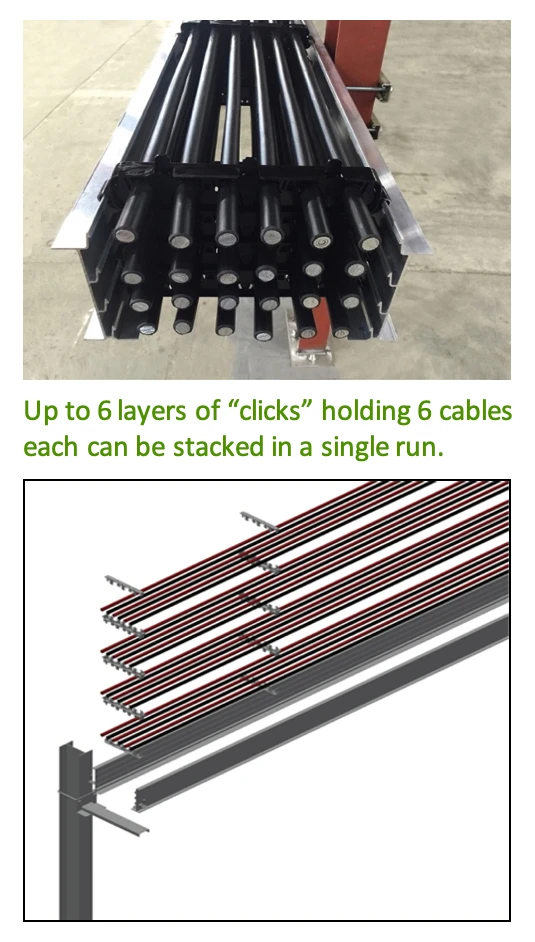
- Conductor savings. Solar Snake Max™ allows for lower ampacity cables to be used to their full capacity, reducing project costs.
- Material savings. Solar Snake Max™ can be supported by tensioned messenger wire, hard rails, enclosed in ventilated shafts for BESS applications and even used in utility retention ponds. In every case, the system leverages the same piles driven into the earth (or floating pontoons) to support the solar panel arrays and attaches with common hardware.
- Labor savings. Above ground cable conveyance minimizes earth moving equipment and trenching. Solar Snake Max traverses any kind of terrain, allowing for faster install and cable loading by installers.
- Operations and Maintenance (O&M) savings. Post-construction, Solar Snake Max™ provides easy access to the cable plant with 100% visibility for pinpoint repairs and system expansion without digging.
- Lifetime investment with maximum uptime. Solar Snake Max™ clicks are manufactured from durable insulated polycarbonate material for weather resistance with high dielectric strength. Clicks are designed to last for the life of the solar plant (estimated at 20 to 30 years) without the risk of metal touching metal. Should a conductor’s insulation ever be compromised, Solar Snake Max has the ability absorb the fault current without shutting down the entire plant. Electrons (and dollars) keep flowing to maximize ROI. Always. No other system can make that claim.
- Consistent fixed spacing and proper support. Solar plant performance is not impacted by environmental conditions or panel structure movement caused by thermocycling. Cables are always separated by at least one cable diameter without sagging, allowing wind to carry away heat for true free-air NEC-compliant performance.
The bottom line is that Solar Snake Max™ improves your bottom line by speeding project completion while increasing watt hour production for added revenue generation.
Dig a little deeper
Want to learn more about the science behind Solar Snake Max that unlocks the full potential of your next solar investment?
Dive into the physics of thermal management to learn why free-air cable conveyance outperforms buried or bundled cabling methods in our white paper, The Benefits of Cable Separation.
And check out this blog, Hey Solar Plants, Stop Leaving Electrons (and Money) on the Table, for real world calculations of how much incremental power and revenue Solar Snake Max can generate for your next solar plant.
Investors make more with Solar Snake Max™. Easy as 1-2-3.
Solar Snake Max increases your ROI by:
- Shortening time horizons to operational status and revenue generation.
- Maximizing energy throughput with less labor.
- Maintaining NEC-compliant true free-air ampacity for the life of the project.
Meet your utility contractual obligations with Solar Snake Max™. It’s the only above ground cable management system investors should endorse to their constructors when seeking maximum ROI.
Partner with us and we’ll make sure your next solar energy investment pays off handsomely. We are Snake Tray®. We are cable management.