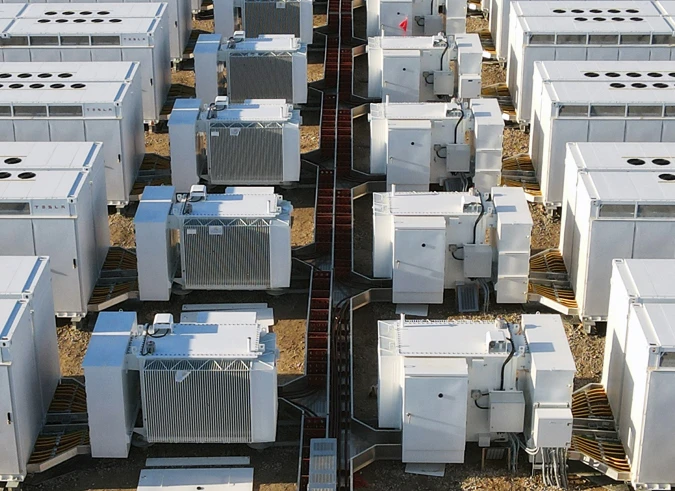
Cable conveyance is one of most overlooked yet mission-critical aspects of utility-scale energy plant design. Whether power is generated from fossil fuel or renewable sources, pumped directly to the grid or temporarily stored in a battery array, poor cable management can result in reduced energy harvest, safety hazards, spiraling maintenance costs, material waste, shortened asset lifespans and operational delays.
This article makes the case for free-air cable conveyance and offers essential guidance for better outcomes when planning the cabling of a Battery Energy Storage System (BESS) with Snake Tray’s Snake Max®.
A BESS Defined
A BESS is a bank of industrial strength batteries, each roughly the size of a shipping container, used to store and release excess electricity to consumers as needed. A BESS might be connected to the public grid allowing utilities to better meet peak period demand, or it may serve as an auxiliary power source for a privately owned hyperscale data center, hospital, or industrial complex, for example.
BESS Cabling Options: Buried or Free-Air
Engineers have two choices when designing the cable conveyance for a BESS: buried or free-air.
Buried Cable Conveyance
Burying cables underground is a time and labor-intensive process of digging, laying cables and backfilling trenches that stretch from the energy source to the battery array. Hidden obstacles (boulders, roots, pipes/abandoned infrastructure, water features, etc.) can impede progress. Buried cables trap heat, so they must be derated or stepped up in ampacity to compensate for the insulative effects of buried or bundled cables, increasing conductive material costs by 25% to 40% . Once buried, a lack of visibility makes pinpointing cable faults difficult and requires more digging to expose and repair.
Free-Air Cable Conveyance
Moving cable conveyance above ground solves all the problems associated with burial. There’s no trenching or heavy earth moving equipment needed; just support piles hammered into the ground. Free-air conveyance handles any type of terrain and distance yet remains immune to changing geological and soil conditions. Cables are loaded faster with total visibility to the cable plant for simplified maintenance. Most importantly, above ground cable conveyance maximizes ROI by eliminating the need to derate cables, simultaneously reducing conductive material requirements while harvesting up to 8% more metered energy than buried cables.
The Economics of BESS Free-Air Cable Management
Battery energy storage systems are gaining in popularity due to a sharp increase in electricity demand (data center power consumption being a key driver), to stabilize energy supplies and surprisingly, because of their ability to generate revenue.
Yes, a BESS can be a profit center as well as an expense reducing asset.
With a BESS, utilities store excess power produced cheaply during the day and discharge it to the grid when energy rates are higher, boosting output and creating revenue without firing up gas or fossil fuel-powered turbines. Businesses connected to a BESS can tap into cheap power on demand to lower peak period electricity consumption and insulate operations from outages – critical to 24×7 entities like data centers and hospitals.
Another primary benefit of free-air cable conveyance is the shortened time horizon to going online. Moving the entire cable plant above ground – high voltage DC cables running from the power source trunk lines to the battery arrays, medium voltage cables connecting batteries to inverters and transformers, and low voltage data, auxiliary and fire suppression circuits – speeds project completion enabling the BESS to begin generating revenue weeks or months sooner than a trenched project typically allows.
Snake Max for BESS is the Best
And the best above ground cable conveyance system for a BESS is Snake Tray’s patented Snake Max® for Battery Energy Storage Systems.
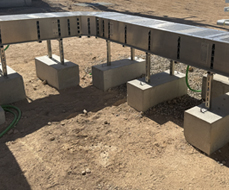 Snake Max for BESS is the only solution that provides consistent support while maintaining end-to-end cable separation equal to at least one cable diameter as mandated by NEC Table 310.17, allowing for natural heat dissipation into the surrounding air to maximize energy throughput. Cables up to 1250 Kcmil are managed by a system of brackets and “clicks” that snap together to securely hold multiple layers of cables.
Further, Snake Max is power-source agnostic. It works equally well with traditional fossil fuel (coal/natural gas), peaker and nuclear power plants, renewables (solar/wind/geothermal), and even next-generation hydrogen fuel cell modules. Wherever electrons come from, Snake Max can efficiently deliver them to a BESS.
For these reasons you might be considering Snake Max to cable your next BESS. But even with above ground cable conveyance there’s more to it than meets the eye.
Design Considerations When Cabling a BESS
Think about these site-specific factors when planning your next BESS array to best leverage the benefits of above ground cable conveyance. Then reach out to the cabling experts at Snake Tray. We can help you plan for contingencies you might not have considered before you commit resources to cabling.
Civil Engineering Concerns
This refers to the site plan layout and space requirements for cable pathways and how that impacts installation, maintenance and the size of the project. Roads, natural boundaries, water tables and soil conditions must be considered.
Buried cables must be spaced sufficiently apart to allow for heat dissipation. Depending upon ground thermal resistivity (a fancy way to say heavier earth like peat and clay retain more heat than sandy soil), each high and medium voltage cable may have to be separated by several feet. For a BESS with dozens of batteries this could mean excavating huge amounts of soil to set the cables far enough apart, resulting in wide corridors between arrays that vastly increase overall BESS plot size and require more conductive materials to reach their terminations.
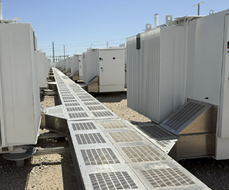
Above ground cable conveyance increases the energy density of a BESS by allowing for closer spacing between rows of equipment and cables. Snake Max eliminates trenching and shrinks the entire footprint of a BESS to generate more watts per square foot by organizing cables into compact, streamlined pathways requiring only 1″ of separation between cables, reducing land and conductive material costs. Snake Max easily traverses roads, streams and provides access to cables from either side of the run.
Tip: Above ground cable conveyance eliminates the need to diagram and mark subterranean cable paths and junction points (which are never exactly where the map shows due to hidden obstacles and seismic activity over time).
Structural Engineering Concerns
Each BESS component – battery, inverter, transformer – arrives from the manufacturer fully assembled with factory-installed ingress and egress points for attaching cables. Most times these interfaces are located on the bottom of the units, as the components were originally designed to connect to cables that were often buried beneath them.
Taking cable conveyance above ground requires elevating BESS components to access those bottom interfaces. A key consideration here is maintaining cable bend radius as per cable manufacturer and NEC specifications; you can’t just kink a high voltage cable 90°.
Snake Tray can help define the required equipment elevation level to allow for the maximum flow of electrons through the cables, and then design and produce a repeatable conveyance system with a bend radius that precisely meets those dimensions.
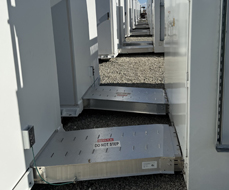 Elevating BESS components can significantly add to costs if not done correctly. Consider that each battery requires six to eight support pilings to sit on. Now let’s assume the engineers allocated 24″ of vertical space to allow for cable ingress/egress. That means a 100-unit BESS raised two feet adds 1,200 to 1,600 linear feet of steel to the project’s bill of materials. Consulting with Snake Tray first might reveal a 12″ elevation is sufficient to achieve the proper bend radius given the cable diameter, saving 50% on piling materials while still reaping the benefits of free-air cable conveyance.
Tip: Bend radius is defined as a multiple of the cable diameter. For example, a high voltage cable might have a bend radius of 16 times the cable diameter, a medium voltage cable might have a factor of 12 times the cable diameter, while a low voltage cable might have a tighter bend radius of 8. These numbers dictate the arc of the bend for NEC compliance.
Electrical Engineering Concerns
Issues here involve ensuring adequate cable clearance above the ground to maintain a 360° air flow around the cables as per NEC Table 310.17, and minimizing the occurrence of electrical faults.
Buried cables are susceptible to damage from exposure to constant heat, pressure, geologic events, frost heave, tree roots, moisture and subterranean insects. Even acidic soils (limestone, caleche) can eat away at cable jacketing over time. When a fault occurs underground, pinpointing and repairing or replacing the cable can be difficult. Free-air cable conveyance significantly mitigates these ground-caused fault events but does not eliminate them. Cables will eventually fail over time.
When a fault does occur, bad things can happen. Over time, material and cable jacket fatigue can add to stress on conductors, resulting unintended interaction of electrons between cables. The Lorentz Force is an electromagnetic phenomenon that causes charged electrons to repel nearby cables so intensely it can trigger an event that literally blows a cable conveyance system apart.
Snake Max is specifically designed using steel and high strength polycarbonate components to withstand the maximum fault potential of each system without damaging the conveyance. The trefoil cleats used in the Snake Max Megapack LV modules are rated to 135kA resistance to electromechanical forces, maintaining system integrity in the event of a fault. Of course, the affected cable(s) will need replacement, but it’s much easier to drop a new cable into Snake Max than it is to locate, excavate and replace a buried one.
Tip: Determine the greatest possible amount of fault current that could be generated by the BESS and design the cable conveyance system to be strong enough to contain it.
Operations & Maintenance (O&M) Concerns
Post-construction, technicians must be able to spot faults, access and replace degraded cables, or even add more conductors should the BESS be expanded. Maintenance crews should be able to control vegetation and pests without risking damage to the conveyance system.
Free-air cable conveyance achieves those objectives. First, Snake Max moves the entire cable conveyance above ground, removing exposure to most of the factors that cause faults. Second, visibility to all cables makes it easy to pinpoint, access and fix flaws with minimal downtime. Buried cables require additional time, labor and machinery to excavate, locate and replace.
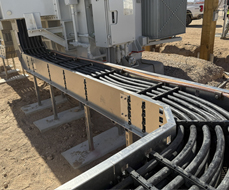
Tip: Snake Max offers ventilated covers (circled) that maintain air flow to NEMA standards and simplify access while protecting cables from damage caused by pests and rodents, falling objects, and vegetation control equipment like lawn mowers and trimmers.
Free Advice? Yes Please!
Regardless of the power source, Snake Tray wants to see your next BESS project succeed. The earlier you bring Snake Tray into the planning stages of your project, the more value we can add by:
- Offering engineering expertise to optimize project design as part of our services.
- Leveraging infrastructure already on site by attaching cable conveyance components to existing BESS support structures, minimizing costs.
- Homogenizing structural support elements. Should additional materials be required for cable conveyance or BESS elevation (concrete pilings, steel beams, nuts and bolts, etc.), we’ll source more of the same parts from the same suppliers wherever possible to achieve economies of scale and preserve established installer workflows.
- Prefabricating identical customized components such as turns with the proper bend radii to streamline battery connection through repeatability.
With Snake Max for BESS, you have nothing to lose except excess heat generation.
Call us today!