
We can’t build data centers fast enough. A quick Google search shows over 2,700 new data centers are planned or currently under construction across the U.S. in 2026, ranging from small edge sites to co-location facilities and hyperscale campuses. This unprecedented expansion is being fueled by the rapid adoption of AI, machine learning, cloud and streaming workloads. These applications require huge quantities of electricity to power and cool the vast arrays of computers, data storage and networking resources that run them.
Building a data center of any size is no easy task. These projects typically involve complex infrastructure, massive power and cooling requirements, and strict schedules to meet growing demand. Traditional methods often struggle to keep up with the pace and scale required.
Here’s the thing about data center construction: the faster you build them the sooner they start generating revenue. And the race is on. In fact, many developers are erecting multiple data centers simultaneously. This is creating enormous pressure on contractors to meet deadlines and on suppliers to deliver components in the quantities needed for all the sites under construction.
The Limitations of Traditional Data Center Construction
Traditional data center construction relies heavily on on-site assembly and customized engineering for each facility; luxuries builders can no longer afford. One of the biggest challenges is time. Data centers can take years to design and build. With traditional construction, most infrastructure work happens sequentially; site preparation is followed by structural construction, mechanical installation, electrical work, and finally system integration.
Labor constraints is another issue. Skilled construction and electrical workers are in high demand and large projects often compete for the same talent, creating labor shortages that drive up hourly wages. Traditional construction can also lead to inconsistencies across sites. When each server farm is built from the ground up, differences in workmanship, design, and site conditions can result in variations that affect performance, quality, cost and timing.
For data center engineers seeking to design and deploy new sites rapidly and consistently across multiple regions, these limitations result in operational and financial headaches.
Understanding Data Center Prefabrication and Modular Design
Many data center builders are turning to prefabrication and modular construction techniques to address these challenges. Manufacturing key components off-site and/or purchasing prefabricated subsystems to install on location allows data center operators to significantly speed deployment, standardize builds across multiple sites, lower costs and reduce risk.
Toward that end, data center architects are templating their designs for easier replication. Every square inch of these high density structures is scrutinized to maximize space utilization/revenue generation and minimize power/cooling requirements.
5 Benefits of Data Center Prefabrication
- Speed. Whereas traditional construction happens sequentially, prefabrication allows many processes to happen in parallel, shortening project timelines by several months. While the building shell is being completed, prefabricated infrastructure components and subsystems are manufactured and assembled off site and readied for timely delivery and swift installation.
- Repeatable and standardized infrastructure. Data center developers rarely build just one facility. Most manage networks of data centers across countries and continents to reduce latency. Maintaining consistency across distributed sites is essential for operational efficiency, maintenance and reliability. Prefabrication enables repeatable infrastructure design. Once a system has been architected and validated, it can be replicated across locations with minimal modification. Installers benefit from familiar workflows for every project, removing complexity and delays caused by on-site customization, while developers realize faster permitting and approvals.
- Improved supply chain logistics. Equipment delays, material shortages and transportation challenges all can impact construction schedules. Prefabrication helps mitigate the risks of supply chain disruption and simplify logistics. Exact quantities of components can be sourced and assembled within a controlled environment, reducing uncertainties associated with on-site assembly. Instead of coordinating the delivery of thousands of individual parts, construction teams receive finished components and subsystems that can be installed in fewer steps.
- Cost and risk reduction. Prefabricated parts can be purchased in bulk to achieve consistency and economies of scale. Performing quality assurance testing at the factory prior to shipment is a far less expensive and time-consuming process than troubleshooting equipment after installation. Reducing on-site fabrication also improves safety. With fewer workers performing complex installations in the field (welding, grinding, cutting, etc.), the risk of accidents and disruptions decreases.
- Supporting Sustainability and Efficiency Goals. Data centers consume significant energy resources and are being pressured by local communities to minimize environmental impact. Prefabrication contributes to sustainability efforts through less waste, the opportunity to use more energy efficient building materials and systems for power and cooling, reduced greenhouse gas emissions by transporting less unfinished raw materials to the job site, and minimizing heavy equipment usage during construction.
Data Center Prefabricated Components
Which parts of a data center can be prefabricated? Just about all of it.
Rather than pouring and curing cement on-site, premanufactured concrete slab wall sections are quickly raised into position using tilt-up construction techniques. Windows, doors and stairways arrive ready for installation, significantly reducing the amount of field fabrication.
Inside the building prefabricated modules include power distribution units, air conditioning and cooling systems, water pumps and chiller plants, backup power systems, lighting fixtures, as well as the cages, server racks and cabinets that house the computers and networking hardware.
Because engineers know exactly where and how many rows of cages and servers will be installed, they can now plan cable pathways during the design phase rather than approaching cable conveyance as an afterthought.
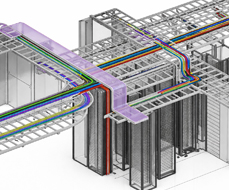 With access to advanced tools like 3D color-coded Building Information Modeling (BIM) programs to identify potential conflicts with HVAC systems and ductwork, electrical and plumbing lines, and security and fire suppression systems, engineers can now see exactly where to route cables and when to modify pathways around obstructions.
As a result, data center architects can generate tight estimates for the total linear footage of cable trays, the precise tray width and depth needed for the volume of cables running to each part of the data center and calculate the exact number of fittings and accessories needed to complete the job. With more accurate drawings, installers know exactly what they must do and can proceed faster without delays from change orders.
This is where Snake Tray’s prefabricated cable conveyance speeds the time horizon to online status, shaving hundreds of hours off installation time compared to generic wire basket trays.
801 Series Mega Snake: Data Center Prefabricated Cable Conveyance
|
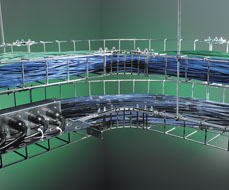
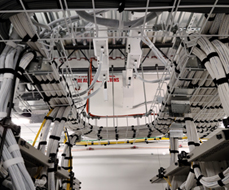
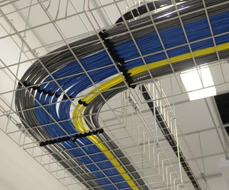
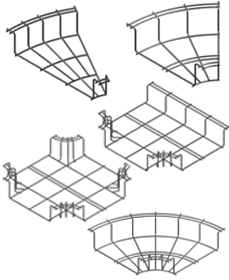
Snake Tray’s 801 Series Mega Snake® is hands-down the fastest, easiest and most cost efficient solution for installing high capacity cable conveyance in today’s data centers. Constructed from .25” recycled galvanized steel rods, Mega Snake is designed with 4” grid spacing to combine the structural strength of a ladder tray with the lightweight flexibility and continuous support of a basket tray for higher load capacity. Factory-engineered waterfalls and cable dropouts are available for side, over-rail and bottom egress. These components maintain manufacturer-stipulated bend radii as cables transition from tray to racks or cabinets. Mega Snake features an integrated suspension system and accessory rail that eliminates the need for brackets and struts, reducing SKUs and installation complexity. Tray sections connect in under one minute with patented splice kits that provide a continuous UL Classified ground, delivering consistent results regardless of installer experience. However, data center cable pathways frequently require turns, elevation changes, and tray size reductions in areas of lower cable density, and that’s where the 801 Series Mega Snake really shines. The 801 Series Mega Snake provides factory-made horizontal and vertical reducing transitions, Tee’s, crosses, and turns (30°, 45° and 90°) that can be installed in under five (5) minutes versus the 45 minutes it takes to build one on-site, eliminating hundreds of hours of field fabrication, speeding time to revenue generation. |
|
Mega Snake Speeds Time to Revenue Generation
The proof is in the savings. Let’s do the math using $90/hour as the median wage rate for a skilled electrician in a real world example. Snake Tray is the selected cable conveyance provider for a hyperscale data center under construction in Texas. Thanks to BIM modeling, engineers were able to identify 550 fittings that would be required for the cable conveyance system.
Generic Basket Tray
550 fittings @ 45 minutes per fitting
= 24,750 minutes
24,750 ÷ 60 = 412.5 hours
412.5 x $90/hour rate = $37,125
801 Series Mega Snake
550 fittings @ 5 minutes per fitting
= 2,750 minutes
2,750 ÷ 60 = 45.8 hours
45.8 x $90/hour rate = $4,122
The result is an amazing 9:1 ∆ (delta) in time and labor savings with Mega Snake just for the construction of cable tray fittings. While most developers would consider $33,000 in labor savings a drop in the bucket when building a $1 billion data center, it is the time savings that is of significant interest.
Mega Snake saves 366 hours of on-site fitting fabrication time, equivalent to nine 40-hour work weeks. That’s nine weeks faster to be ready for cable loading and thus nine weeks faster to revenue generation. In the time it takes to create one 90° turn with a generic basket tray, the Snake Tray installer has connected nine tray sections (including any fittings) with Lego®-like ease. With data center revenues counted in the hundreds of thousands of dollars every week, Snake Tray’s prefabricated fittings can contribute millions to a project’s bottom line by getting the facility online months sooner than could be achieved with traditional construction methods.
Standardize on Mega Snake and Save!
By eliminating field fabrication and standardizing installation practices, Mega Snake delivers faster deployments with predictable performance and structural integrity designed to last for the lifetime of the facility.
Most importantly, Mega Snake is available. Whereas most cable tray manufacturers are maxed out and quoting long lead times for product delivery, Snake Tray has tripled its welded wire grid factory production capacity to keep pace with industry demand to meet your needs today.
At Snake Tray, we’re ready, willing and able to deliver the prefabricated cable conveyance solutions that bring data centers online and generate revenue faster. Contact us to learn how Mega Snake can rise to your next data center construction challenge.